Materia Medica · Dravyaguna
Shirisha
Albizia lebbeck · Fabaceae
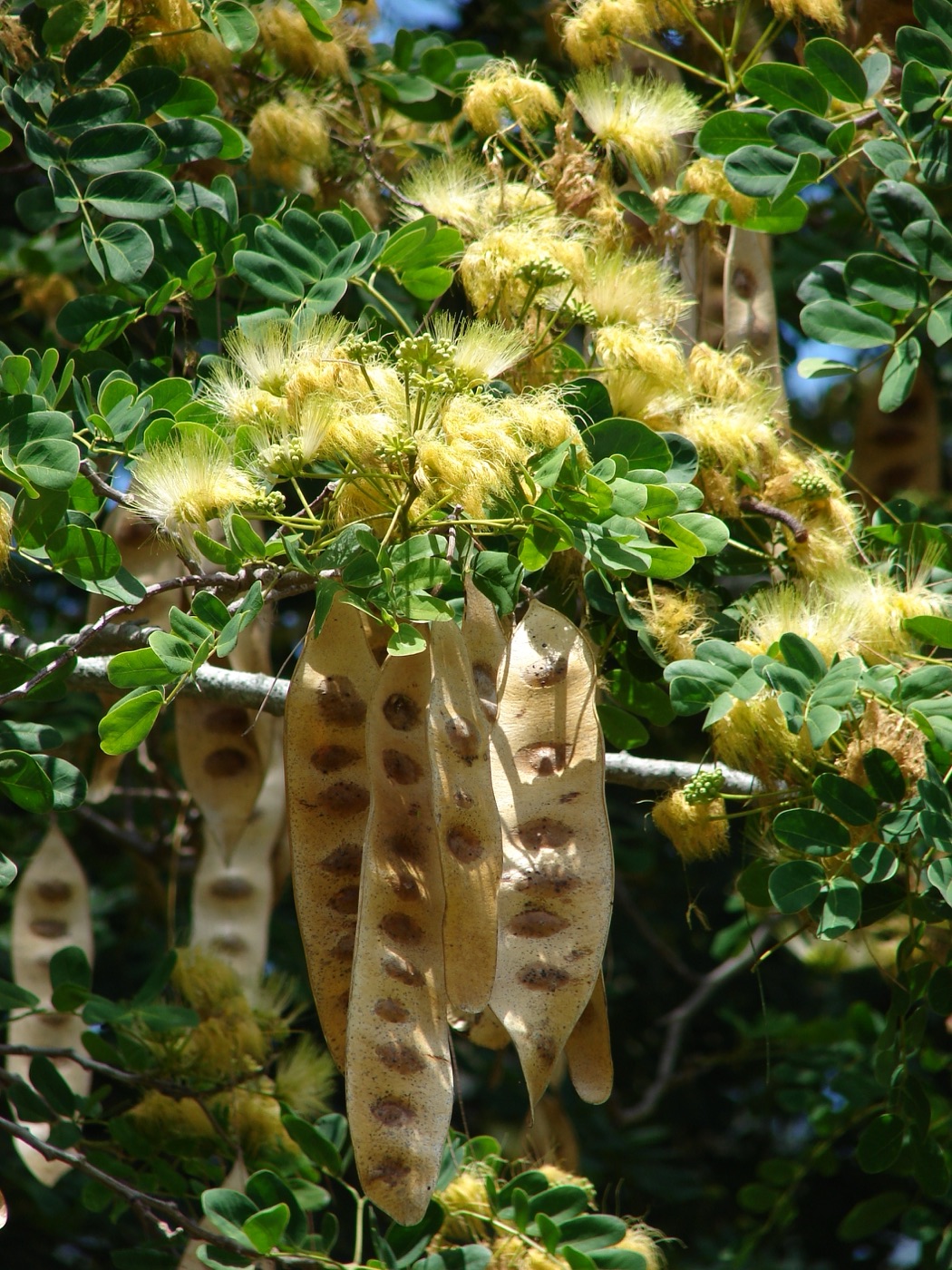

Shirisha is a large flowering tree of India, valued in Ayurveda above all as a Vishaghna, a herb that counters toxins. The old texts name it first when they speak of the reactions the tradition understands as toxic in nature.
- Botanical name
- Albizia lebbeck
- Family
- Fabaceae
- Sanskrit
- शिरीष
- Part used
- Bark, seed, flower and leaf
- Taste (rasa)
- Bitter, astringent and sweet (tikta, kashaya, madhura)
- Quality (guna)
- Light and penetrating (laghu, tikshna)
- Energy (virya)
- Neither strongly heating nor cooling, tending warming (anushna)
- After digestion (vipaka)
- Pungent (katu)
- Action (karma)
- Counters toxins, clears Kapha, answers worms (vishaghna, kaphahara, krimighna)
- Effect on dosha
- Settles all three, with a special note against toxins (tridoshahara, vishaghna)
- Best known for
- The classical tree Ayurveda names first among the anti-toxin herbs
What is Shirisha?
Shirisha is a large, spreading flowering tree, Albizia lebbeck, of the legume family, common across the plains and lower hills of India. It is a tree you notice: a broad, shady crown, feathery leaves that fold together as the light fades, and in season a mass of pale, silky flowers whose fine stamens give the whole tree a soft, brushed look. The long, flat pods that follow rattle in the wind when they dry, which has earned the tree the country name of the woman’s-tongue tree.
Ayurveda draws on several parts of it: the bark, the seed, the flower and the leaf. English speakers know the same tree as the lebbeck tree, the siris tree or the Indian walnut, and in the languages of India it is Vaghe or Kokko. Whatever the name, it is the tree the classical writers reach for first when they speak of the herbs that answer toxins, and it is by that reputation, as a leading Vishaghna, that Shirisha is best known.
What Ayurveda uses it for
Shirisha belongs above all to the Vishaghna group, the herbs Ayurveda counts as answering Visha, or toxins. Charaka places it among the ten anti-toxin herbs of the Vishaghna Mahakashaya, and the later writers repeat the point plainly: of the trees that counter poison, Shirisha stands foremost. The tradition understood this action broadly. Visha covered not only ingested poisons and the bites and stings the old texts describe, but also the wider class of reactions the physicians grouped as toxic in nature, which included what a modern reader would recognise as an allergic tendency.
From that central role the dravyaguna texts describe the bark, flower and seed as traditionally indicated in a familiar set of conditions, each named here in its classical Sanskrit term with a plain gloss:
- Visha: toxins and the reactions the tradition groups as toxic, including what would today be thought of as an allergic tendency, the tree’s classical home.
- Kushtha: the broad class of skin disorders, where its bitter, clearing quality was called upon.
- Shwasa and Kasa: laboured breathing and cough, in particular the varieties the tradition linked with a toxic or allergic character.
- Kandu: itching of the skin.
- Shotha: swelling.
- Shvitra: a discolouration of the skin.
These are the traditional textual indications recorded in the classical literature. They set out how Ayurveda has long understood the herb and are given for reference and study, not as statements of medical effect or as advice to treat any condition.
Its qualities, in plain words
Ayurveda describes every herb by a short list of qualities, and for Shirisha they sit neatly behind its reputation as a clearing, anti-toxin tree.
Its taste is bitter and astringent, with a sweet undertone, and in Ayurveda a bitter, astringent taste is the taste that cleans, dries and draws things together rather than feeding them. It is light and penetrating, so it moves and clears rather than settling and building, which is why the texts group it with the herbs that reach into the tissues to answer a toxin. Its potency is described as anushna, neither strongly heating nor strongly cooling, though it is read as leaning gently towards the warming side. And it finishes pungent after digestion, in keeping with its clearing, Kapha-reducing character. Put together, these qualities describe a light, penetrating, cleansing herb. The tradition counts it as tridoshahara, settling to all three doshas, while singling it out above all for its action against toxins.
How it is taken
The classical writers used several parts of the tree. The bark, taken as a powder or simmered into a decoction, is the most common form. The seed and the flower are also named, and the fine hairs and other parts appear in particular preparations. As with many clearing herbs, the vehicle was chosen to suit the aim, with warm water or honey among the carriers the texts favour.
Shirisha lends its name to a handful of classical preparations. It is the herb of Shirishavaleha, a medicated confection, and of Shirisharishta, one of the fermented herbal preparations known as arishta. Beyond the preparations that carry its name, it is a recurring ingredient in the classical Vishaghna formulations, the anti-toxin recipes in which the old texts set it alongside other herbs of the same group.
Good to know
Shirisha is one of the clearing, answering herbs rather than one of the slow, building tonics, and its classical place is firmly among the Vishaghna group. The tradition draws on more than one part of the tree, the bark most of all, but also the seed and the flower, and the part chosen depended on the preparation. As a large and widespread tree of India, it has long been familiar in daily life as much as in the pharmacy, which is part of why the texts return to it so often.
This entry describes the classical Ayurvedic understanding of the herb. It is not medical advice, and anyone with a health condition should speak to a qualified practitioner.
Frequently asked
Why is Shirisha called an anti-toxin herb? Because the classical texts place it in the Vishaghna group, the herbs understood to answer Visha or toxins, and name it foremost among them. In the older sense Visha was a wide category that took in not only poisons and bites but also the broader class of reactions the physicians grouped as toxic in nature.
Which part of the tree is used? Several. The bark is the part named most often, taken as a powder or a decoction, but the seed, the flower and the leaf all appear in the classical literature, with the choice depending on the preparation.
Is Shirisha heating or cooling? Neither strongly. The texts describe its potency as anushna, neither markedly heating nor markedly cooling, though it is generally read as leaning a little towards the warming side, in keeping with its light, penetrating, clearing character.
Among the herbs that answer poison, Shirisha is held the foremost; its bark, flower and seed all serve against toxins.
After the Bhavaprakasha Nighantu, on the anti-toxin herbs
Shirisha counters toxins, clears Kapha and settles the reactions the texts group as poison.
After the Charaka Samhita, on the Vishaghna group
Frequently asked questions
What is Shirisha used for?
Shirisha (Albizia lebbeck), a broad flowering tree, is counted by Ayurveda as a leading Vishaghna, the group of herbs that answer toxins and the reactions grouped with them. Its bark, seed and flower are used to counter toxins, clear Kapha and answer worms (vishaghna, kaphahara, krimighna). Bitter, astringent and sweet in taste, it settles all three Dosha with a special note against toxicity.
Why is Shirisha called an anti-toxin herb?
The classical texts name Shirisha first among the Vishaghna dravyas, the anti-toxin group, so the tradition reaches for it where toxins and toxic reactions are the concern. Its bitter, tridosha-settling nature is understood to counter such influences in the body. This is a classical framework of understanding, and any serious poisoning or reaction is a medical emergency for a doctor, not a herb alone.
What are the benefits of Shirisha?
Ayurveda associates Shirisha above all with countering toxins (vishaghna), and also with clearing Kapha and answering worms (krimighna). Because it settles all three Dosha, it is a broadly balancing tree, traditionally used for the skin, the breath and reactions the texts link with accumulated toxins. Its bark, seed and flower are each used in classical preparations for these ends.
How is Shirisha used in Ayurveda?
The bark, seed and flower of Shirisha are all used, taken internally as powder or decoction within classical formulas and applied externally in pastes for the skin. Different parts are chosen for different aims within its Vishaghna and skin uses. Because it is a specific, potent dravya, its internal use is best set and supervised by a qualified practitioner.
Which dosha does Shirisha balance?
Shirisha settles all three Dosha (tridoshahara), which makes it broadly balancing, with the texts adding a special emphasis on its action against toxins (Vishaghna). It particularly clears Kapha as well. This tridoshic, anti-toxin character is why the tradition regards it as a safe, versatile tree, though its more pointed uses are still best guided by a practitioner.
References
- Charaka Samhita, Sutrasthana, chapter 4, among the Vishaghna Mahakashaya, the ten anti-toxin herbs.
- Sushruta Samhita, Kalpasthana (Visha-kalpa), among the herbs used against toxins.
- Bhavaprakasha Nighantu, Vatadi Varga, entry on Shirisha with its synonyms and properties.
- Ashtanga Hridayam, Uttarasthana, on the management of toxins (Visha) and skin disorders (Kushtha).
- Raja Nighantu, listing the Sanskrit synonyms of the tree.