Foundations
Sushruta Samhita
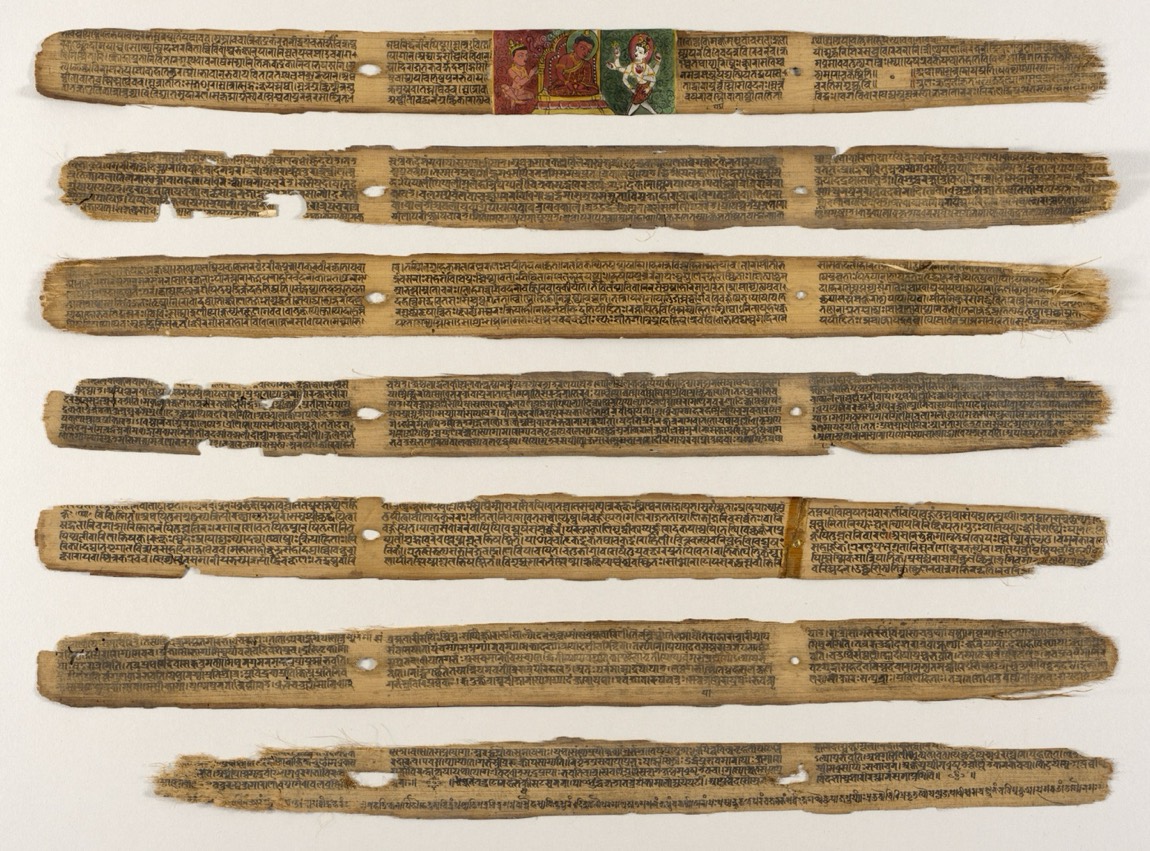
_LACMA_M.87.271a-g_(1_of_8).jpg)
The Sushruta Samhita is the great classical text of Ayurvedic surgery: a Sanskrit treatise, attributed to the teacher Sushruta, that set down the surgical side of Ayurveda in remarkable detail.
- Sanskrit
- सुश्रुत संहिता
What the Sushruta Samhita is
The Sushruta Samhita is one of the foundational texts of Ayurveda, and the one most concerned with surgery. The word samhita means a collection or compendium, and the text gathers the teaching attributed to Sushruta, a teacher of the surgical tradition. It is written in Sanskrit, in the dense verse-and-commentary form of the classical texts.
Within Ayurveda, surgery is called Shalya Tantra, and the Sushruta Samhita is its great reference. Where the Charaka Samhita is remembered above all for medicine and the inner workings of the body, the Sushruta Samhita is remembered for the work of the hand: instruments, procedures, and the close knowledge of the body that surgery demands.
Its place in the tradition
Ayurveda counts three great classical texts together as the Brihat Trayi, the “great three”: the Charaka Samhita, the Sushruta Samhita, and the Ashtanga Hridayam of Vagbhata. The Sushruta Samhita is the second of these. Its standing is bound up with the surgical tradition it carries, which is more fully set out here than anywhere else in the classical corpus.
The text comes down to us in a redaction that was shaped over a long period, and a later section, the Uttara Tantra, was added to round it out into a more complete work. Tradition traces the surgical teaching itself back to the lineage of Dhanvantari, the figure revered in the tradition as the patron of healing.
How the text is arranged
The Sushruta Samhita is divided into sections, called sthanas, each with its own concern.
The Sutrasthana lays the foundations: what Ayurveda is, the eight branches of the tradition, the qualities expected of a surgeon, and the long, famous enumeration of surgical instruments, the blunt instruments (yantra) and the sharp ones (shastra).
The Nidanasthana deals with the understanding and classification of conditions, with particular attention to those the surgical tradition concerned itself with.
The Sharirasthana is the text’s anatomy. It is the most detailed account of the body in the classical literature, and it includes the celebrated description of the marma points, the vital sites on the body, which the tradition maps by location and significance.
The Chikitsasthana sets out the management of conditions, including the careful handling of wounds for which the text is well known.
The Kalpasthana treats Agada Tantra, the classical knowledge of poisons and their antidotes.
The Uttara Tantra, the supplementary section added later, ranges more widely, taking in the care of the eyes, ears, nose and throat, the care of children, and general medicine, so that the whole becomes a rounded compendium.
What it is remembered for
A few things give the Sushruta Samhita its lasting reputation.
It describes a method of reconstructing the nose using a flap of the patient’s own skin, a technique later known as the “Indian method” and much studied in the history of surgery.
It sets out a teaching method for surgery built on practice. Students learned cutting on gourds, stitching on cloth and skin, and probing on hollow stems, before they ever worked on a person, an approach to training that the text describes with unusual care.
It gives the definitive classical account of the marma points, the vital sites of the body, a map that the tradition has used ever since.
And, fitting for a surgical text, it gives unusual weight to Rakta, the blood, treating it almost as a fourth principle alongside the three doshas of Vata, Pitta and Kapha.
Why it still matters
For students of Ayurveda the Sushruta Samhita remains the primary source for the surgical side of the tradition, and its anatomy and its account of the marma points are still studied directly. Beyond Ayurveda, the text holds an honoured place in the wider history of surgery, as one of the earliest works to set out surgical knowledge in a systematic way.
This entry describes a classical Ayurvedic text and its place in the tradition. It is offered for educational and historical interest, and is not medical advice.
Frequently asked
Who was Sushruta? Sushruta is the teacher to whom the text is attributed, remembered as a master of the surgical tradition. As with the other classical authors, the historical person stands behind a teaching lineage carried in the text.
What is Shalya Tantra? It is the surgical branch of Ayurveda, one of the tradition’s eight branches. The Sushruta Samhita is its great classical reference.
What is the Brihat Trayi? The “great three” classical texts of Ayurveda: the Charaka Samhita, the Sushruta Samhita, and the Ashtanga Hridayam. The Sushruta Samhita is the surgical one among them.
He who knows the use of the instruments and the work of the hand, and also the texts, is the complete physician.
Classical tradition, after the Sushruta Samhita
Frequently asked questions
What is the Sushruta Samhita?
The Sushruta Samhita is the classical Ayurvedic treatise on surgery, attributed to Sushruta. It is one of the great foundational texts of the tradition, standing alongside the works of Charaka and Vagbhata. It is especially renowned for its detailed account of Shalya Tantra, the branch of Ayurveda concerned with surgery.
Who was Sushruta?
Sushruta is the sage to whom the Sushruta Samhita is attributed, remembered in the tradition as a foremost teacher of surgery. The text presents his teachings as passed to his pupils. He is celebrated for systematising surgical knowledge within Ayurveda, which is why the tradition often calls him a father of surgery.
What is the Sushruta Samhita famous for?
It is best known for Shalya Tantra, surgery, describing surgical instruments, procedures, methods of incision and suturing, and the training of the surgeon, including early reconstructive techniques. Beyond surgery it also covers anatomy, materia medica and general medicine. Its surgical detail is what sets it apart among the classical Ayurvedic texts.
How does the Sushruta Samhita relate to Charaka and Vagbhata?
These three form the Brihat Trayi, the great triad of classical Ayurvedic texts. The Charaka Samhita centres on internal medicine, the Sushruta Samhita on surgery, and the works of Vagbhata, chiefly the Ashtanga Hridaya, distil and harmonise both. Together they are the principal authorities of the tradition, each with its own emphasis.
Is the Sushruta Samhita still relevant today?
It remains a foundational reference in Ayurvedic education and a text of great historical importance, studied for its principles, surgical concepts and its account of Shalya Tantra. It is valued as classical source material rather than a modern clinical manual, and Ayurvedic practitioners read it alongside the wider Brihat Trayi and later commentaries.
References
- Sushruta Samhita, Sutrasthana, on the eight branches and the qualities of the surgeon.
- Sushruta Samhita, Sharirasthana, on anatomy and the marma points.
- Sushruta Samhita, Uttara Tantra, the supplementary section.