Materia Medica · Dravyaguna
Chakramarda (Cassia Tora)
Senna tora · Fabaceae
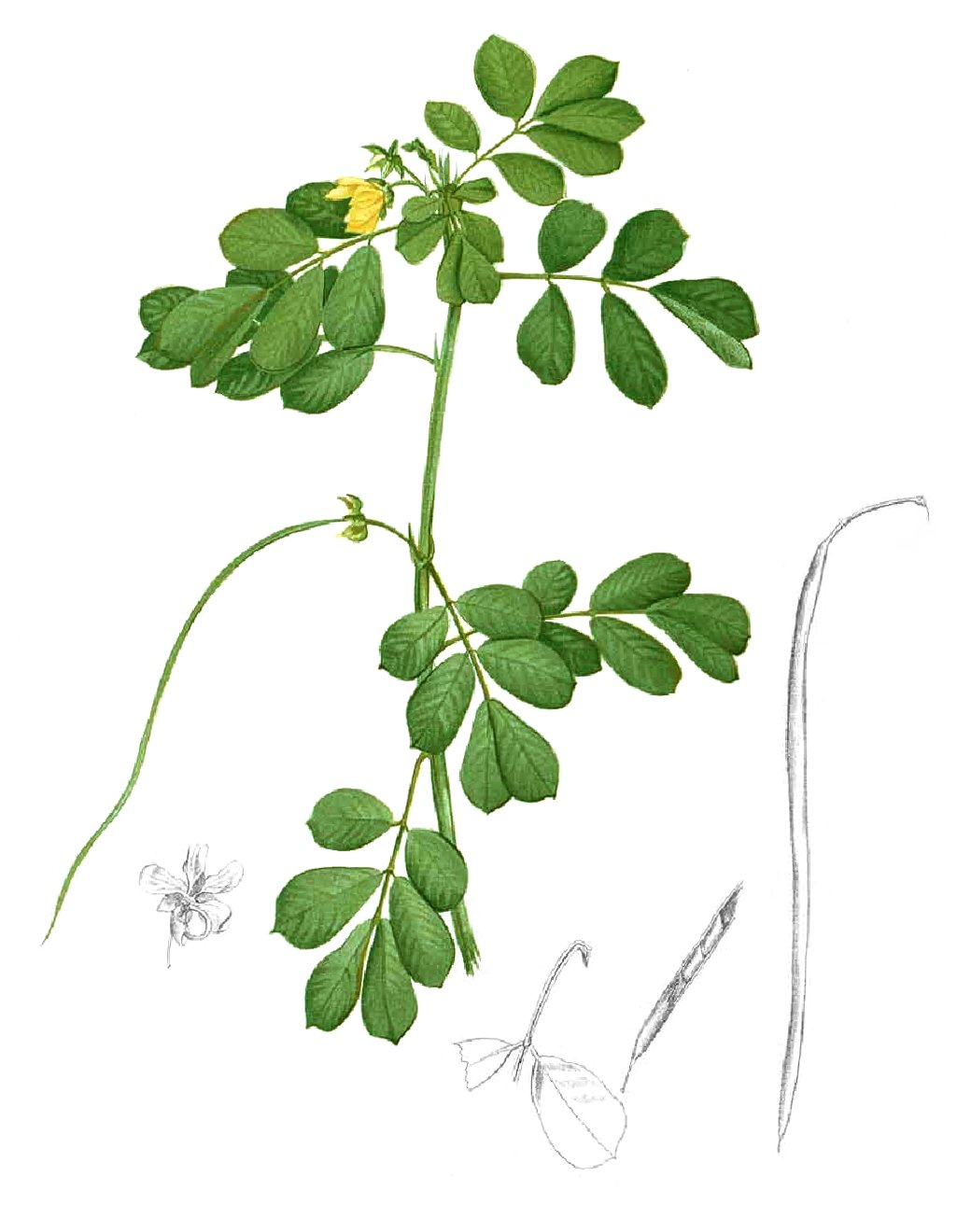

Chakramarda is a low, spreading weed of the rains, familiar across India along paths and field edges. Its seed and leaf are the classic Ayurvedic answer to Dadru, the ringworm-type skin complaint, and both of its best-known names carry that fame within them.
- Botanical name
- Senna tora
- Family
- Fabaceae
- Sanskrit
- चक्रमर्द
- Part used
- Seed and leaf
- Taste (rasa)
- Pungent and bitter (katu, tikta)
- Quality (guna)
- Light and dry (laghu, ruksha)
- Energy (virya)
- Warming (ushna)
- After digestion (vipaka)
- Pungent (katu)
- Action (karma)
- Works on the skin and above all on Dadru, counters worms and settles itching (kushthaghna, dadrughna, krimighna, kandughna)
- Effect on dosha
- Pacifies Kapha and Vata (kapha-vata shamaka)
- Best known for
- The classical herb named against the ringworm complaint
What is Chakramarda?
Chakramarda is a low, spreading annual of the legume family, Senna tora, long known to botanists as Cassia tora and also as Cassia obtusifolia. It comes up with the monsoon rains and is one of the commonest plants of the Indian wayside, found along paths, on wasteland and at the edges of cultivated fields, often in dense stands wherever the ground has been left to itself. It is an unassuming plant: a soft, branching herb a knee or so high, with pairs of rounded leaflets that fold together at dusk, small yellow flowers borne in the leaf axils, and slender, curved pods that give it one of its English names, the sickle senna. Crushed, the fresh leaf gives off a heavy, unpleasant smell, which is why English also calls it the foetid cassia. Ayurveda values two parts of it above the rest: the seed and the leaf, the seed most of all.
The names the tradition gives it are unusually plain about what it is for. Chakramarda is read as the crusher or destroyer of chakra, the ring, a direct pointer to Dadru, the ringworm-shaped skin complaint the plant is named to treat. The synonym Dadrughna says the same thing in the barest terms: the destroyer of Dadru. Two further classical names, Prapunnada and Edagaja, run alongside these in the nighantus, and across the subcontinent the plant carries a string of vernacular names, among them Chakvad. It is rare for a herb to wear its foremost use so openly in its own titles, and Chakramarda does so twice over.
That so common a weed should have earned so definite a name is telling. The classical writers built much of their materia medica from the plants that grew close to hand, and Chakramarda, springing up in abundance with every monsoon, was among the most available of all. A herb that a household could gather freely from the nearest path, and that answered a visible, troublesome complaint of the skin, was worth naming precisely, and the tradition named it for exactly what it did. The nighantus, the classical lexicons of medicinal substances, place it in the Guduchyadi Varga, the group of herbs of a cleansing and clearing cast, and it is in that company, among the light and bitter plants, that its character is best read.
What Ayurveda uses it for
Of all the wayside herbs of the classical materia medica, Chakramarda is the one bound most tightly to a single purpose. Its very names declare it, and the texts bear them out: it is the herb the tradition reaches for in Dadru, the ringworm-type complaint of the skin, most characteristically as the fresh seed ground to a paste and laid on the affected patch. From that central use it widens into the broader family of skin disorders, an action the classical writers describe as kushthaghna, and it is named too among the herbs that counter krimi and settle the itching the texts call kandu.
Ayurveda groups a wide range of skin complaints under the single broad heading of Kushtha, from dry and scaly patches to weeping and eruptive ones, and within that large field Dadru is a distinct, recognisable member: the classical texts describe it as a raised, ringed, itching, spreading patch, and it is this precise picture that Chakramarda is named against. The tradition understood such complaints to arise where a dampness and heaviness had settled beneath the skin, and it matched them with herbs of the opposite nature, dry, light and warming, that could clear that settled quality at the surface. Chakramarda answers that description closely, which is why it holds so firm and so specific a place. The classical writers set it beside the other skin herbs of the same clearing cast, and its bitter, pungent, drying character explains the company it keeps.
Reading across the classical literature, the seed and leaf are traditionally described in the following settings, each given in its Sanskrit term with a plain gloss:
- Dadru: the ringworm-type skin complaint, the herb’s foremost and defining use, classically the fresh seed paste applied externally to the affected skin.
- Kushtha: the broad classical category of skin disorders, the action the texts call kushthaghna.
- Kandu: itching, which the pungent, drying herb is described as settling.
- Pama: a classical eruptive, scabby complaint of the skin.
- Sidhma: another of the eruptive skin complaints named in the texts.
- Krimi: the classical category of worms and small organisms, the herb’s krimighna role.
These are the traditional textual indications recorded in the classical literature. They set out how Ayurveda has long understood the herb and are given for reference and study, not as statements of medical effect or as advice to treat any condition.
Two further points round out the plant’s place in tradition and daily life, noted here only as matters of fact. The young leaves of Chakramarda are gathered and eaten as a pot-herb, a common leafy green in the country districts where it grows, and the roasted seed has long been used as a substitute for coffee. Both uses sit outside the medicinal account but explain why so common a weed has stayed so familiar.
Its qualities, in plain words
Ayurveda describes every herb through a short list of qualities, and Chakramarda’s read as a set that points one way. Its taste is pungent and bitter (katu, tikta), the pair of tastes the tradition links with cleansing, clearing and drying rather than with nourishment. Its nature is light and dry (laghu, ruksha), so it does not weigh the body down or add moisture but rather scours and dries. Its potency is warming (ushna), the quality that lets it work against cold, damp heaviness, and after digestion its effect stays pungent (katu vipaka), a sign of a stimulating, clearing herb rather than a building one.
Put together, this is a light, dry, warming herb of a pungent and bitter cast, the kind Ayurveda understands as moving and clearing at the surface of the body. Those qualities are the plain opposite of the heavy, cold and moist character of Kapha, and they also answer the cold, mobile quality of Vata, which is why the texts describe Chakramarda as reducing both, a Kapha-Vata shamaka. The tradition connects skin complaints of the Dadru kind with a dampness and heaviness lodged beneath the skin, and it is exactly against that picture that the plant’s dry, warm, pungent nature was thought to act. In simple terms, this is a herb the tradition reaches for to dry and clear rather than to feed or moisten.
How it is taken
Chakramarda’s most characteristic use is external, and it is the fresh seed that carries its reputation. Classically the seed is ground to a paste, often with a sharp, thin liquid such as buttermilk or with plain water, and the paste is applied directly to the affected patch of skin in Dadru and the related eruptive complaints. This simple applied paste, laid on the surface where the trouble sits, is the form the tradition names first and returns to most often. The leaf, bruised or made into a paste, is used in much the same external way.
Beyond the applied paste, the seed is also dried and powdered, and the powder enters medicated oils and ointments made for the skin, where Chakramarda sits alongside other herbs of the same clearing, drying character. In these preparations the seed is often combined with plants of a like nature, the classical accounts pairing it in particular with Bakuchi, the other great skin herb of the tradition, so that two well-known skin plants act together in a single external application. It is one of the plants named in classical external preparations for the skin, and the theme holds steady across every form: a pungent, warming, drying herb brought to bear at the surface of the body, chiefly by application rather than by mouth.
Used internally, the dried seed powder is taken in modest measure, the small doses the tradition reserves for a sharp, clearing herb rather than the fuller amounts given to the gentle, nourishing ones. The young leaf, gathered as a green and cooked, sits at the very mildest end of its use, an everyday food rather than a medicine. As with all the sharp, clearing herbs, the tradition used Chakramarda in measured amounts and most often within a considered preparation rather than alone, and its natural home is the applied paste and the medicated oil far more than the internal dose.
Good to know
Chakramarda is one of the sharp, clearing herbs rather than the slow, building ones, and it belongs firmly to the drying, scouring side of Ayurveda. Its long fame is narrow and precise: the tradition prizes it above all for Dadru, the ringworm-type skin complaint, and both of its principal names, Chakramarda and Dadrughna, record that single reputation. It is a herb of the surface, most at home as an applied paste, and its place is with the clearing rather than the nourishing preparations. Because its potency is warming and its whole nature dry and pungent, the classical framing sets it against the cold, damp heaviness of Kapha and the cold, mobile quality of Vata, while a heated, Pitta constitution suits it less well. That it is at the same time a humble pot-herb and a roadside weed only underlines how thoroughly the tradition knew and used the plant growing at its feet.
This entry describes the classical Ayurvedic understanding of the herb. It is not medical advice, and anyone with a health condition should speak to a qualified practitioner.
Frequently asked
Why is Chakramarda linked so closely with ringworm? Because the classical texts name it, above every other use, for Dadru, the ringworm-shaped complaint of the skin, and its own names record this. Chakramarda is read as the crusher of the ring and the synonym Dadrughna means the destroyer of Dadru. The tradition applies the fresh seed, ground to a paste, directly to the affected patch. This is a traditional textual classification, given for reference and study rather than as a statement of medical effect.
Which part of the plant is used? Chiefly the seed and the leaf. The seed, fresh or dried and powdered, carries most of the plant’s reputation and is the part named for its applied pastes and its medicated oils, while the leaf is used in much the same external way. The young leaf is also eaten as a common pot-herb, and the roasted seed has long served as a coffee substitute, though these fall outside the medicinal account.
How is it usually applied? Most characteristically as a paste for the skin. The fresh seed is ground, often with buttermilk or water, and laid directly on the affected patch in Dadru and the related eruptive complaints. The dried seed powder is also worked into medicated oils and ointments for the skin. Its classical use is external far more than internal.
Why is it called the foetid cassia and the sickle senna? Both English names describe the plant plainly. The crushed fresh leaf gives off a heavy, unpleasant smell, which gives foetid cassia, and the slender, curved pods have the shape of a sickle, which gives sickle senna. The Sanskrit names look instead to its use, marking it as the herb that destroys the ringworm complaint.
Chakramarda is pungent, bitter and warming; it is the herb named against Dadru, and it clears the disorders of the skin.
After the Bhavaprakasha Nighantu, on the skin herbs
Its very names, Chakramarda and Dadrughna, mark it as the destroyer of the ringworm complaint.
After the classical dravyaguna account of the skin herbs
Frequently asked questions
What is Chakramarda (Cassia Tora) used for?
Chakramarda is a common wayside legume (Senna tora) whose seed and leaf Ayurveda names above all for Dadru, the ringworm-type skin complaint. The tradition classes it as kushthaghna, dadrughna, krimighna and kandughna, so it works on the skin and Dadru, counters worms and settles itching. It pacifies Kapha and Vata and is used chiefly externally.
Is Chakramarda good for ringworm and skin problems?
Chakramarda is best known as the classical herb named against Dadru, the ringworm-type complaint its own Sanskrit names record. The tradition uses its seed and leaf as kushthaghna and dadrughna for the skin, and kandughna to settle itching. It is applied chiefly as an external paste. For a persistent skin complaint, use it under a qualified practitioner.
How is Chakramarda applied to the skin?
The seed and leaf of Chakramarda are traditionally made into a paste, often ground with a suitable liquid such as buttermilk, and applied over the affected skin, especially for Dadru and itching. This external use lets its kushthaghna and kandughna action work on the spot. The exact method follows the tradition, so a practitioner can guide its use.
What does Dadru mean in Ayurveda?
Dadru is the classical term for a ringworm-type skin complaint, one of the Kushtha or skin disorders, marked by raised, itching, spreading patches. Ayurveda links it to aggravated Kapha and Pitta in the skin. Chakramarda is so closely tied to it that the herb is named dadrughna, the one that counters Dadru, and used chiefly for it.
Which dosha does Chakramarda balance?
Chakramarda pacifies Kapha and Vata (kapha-vata shamaka). Its pungent and bitter tastes and its action on the skin suit the Kapha involved in itching, oozing skin complaints while also settling Vata. Being a drying, skin-clearing herb used mostly externally, it fits the ringworm-type and itching conditions the tradition names it for, rather than heating, Pitta-driven states alone.
References
- Charaka Samhita, Chikitsasthana, among the herbs described for Kushtha, the skin disorders.
- Sushruta Samhita, Uttara Tantra, on the substances used in the care of the skin.
- Bhavaprakasha Nighantu, Guduchyadi Varga, entry on Chakramarda (Dadrughna) with its synonyms and properties.
- Raja Nighantu, listing the many Sanskrit synonyms of the plant, including Prapunnada and Edagaja.
- Ashtanga Hridayam, in the account of the herbs applied externally for skin complaints.