Materia Medica · Dravyaguna
Palasha
Butea monosperma · Fabaceae
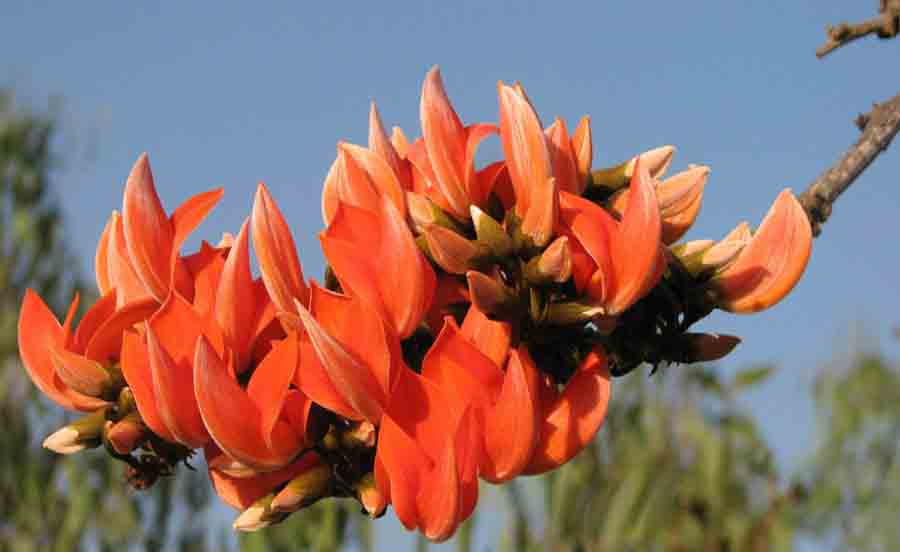

Palasha is a modest forest tree that turns brilliant orange-red in spring, giving it the name Flame of the Forest. Ayurveda uses its seed, flower, bark and red gum, and it is the seed that the classical texts single out as a leading remedy against intestinal worms.
- Botanical name
- Butea monosperma
- Family
- Fabaceae
- Sanskrit
- पलाश
- Part used
- Seed, flower, bark and red gum
- Taste (rasa)
- Pungent, bitter and astringent (katu, tikta, kashaya)
- Quality (guna)
- Light and dry; the seed unctuous and piercing (laghu, ruksha; snigdha, tikshna)
- Energy (virya)
- Warming (ushna)
- After digestion (vipaka)
- Pungent (katu)
- Action (karma)
- The seed acts against worms; the plant is binding and retaining (krimighna, grahi, sangrahi)
- Effect on dosha
- Pacifies Kapha and Vata (kaphavatahara)
- Best known for
- A seed long used against intestinal worms
What is Palasha?
Palasha is a medium-sized tree of the legume family, Butea monosperma, found across the open forest and scrub of India. For most of the year it is unremarkable, with a crooked trunk and broad three-part leaves. Then, in the leafless weeks of spring, it bursts into masses of curved, claw-shaped flowers in a vivid orange-red, so that a stand of the trees looks as though it has caught fire. This display gives it its best-known English name, Flame of the Forest.
The Sanskrit tradition knows it by several names. Palasha is the common one, while Kimshuka points to the flower, whose shape was likened to a parrot’s beak, and English speakers echo this with the name parrot tree. In the plains of northern India the tree is called Dhak, and its flowers, gathered for a bright dye, are known as Tesu. Ayurveda draws on more than one part of the tree: the seed, the flower, the bark, and the red gum that oozes from cuts in the trunk, a substance the tradition calls Palasha niryasa and which trade once knew as Bengal kino.
What Ayurveda uses it for
In the classical texts Palasha is best known for its seed, which the dravyaguna writers count among the foremost Krimighna herbs, those understood to act against intestinal worms. Its pungent, bitter and piercing nature was read as unwelcome to worms, and the seed powder is the part the tradition names most often for this purpose. Beyond the seed, the plant as a whole is described as Grahi and Sangrahi, binding and retaining, qualities the texts connect with its astringent taste and its use where the tradition sought to hold and firm rather than to loosen.
Within that role the classical literature describes Palasha, and chiefly its seed, as traditionally indicated in a set of conditions, each named here in its classical Sanskrit term with a plain gloss:
- Krimi: the classical category of intestinal worms, the seed’s foremost and best-attested use.
- Arsha: haemorrhoids, where the plant’s binding, astringent quality is called upon.
- Gulma: the class of abdominal masses and distensions described in the texts.
- Kushtha: the broad classical category of skin disorders.
- Mutraghata: obstruction or difficulty in the passing of urine.
- Bhagna: broken bone, where the bark and gum are described as a support to healing.
- Pravahika: dysentery with straining, for which the astringent, retaining action was used.
These are the traditional textual indications recorded in the classical literature. They set out how Ayurveda has long understood the herb and are given for reference and study, not as statements of medical effect or as advice to treat any condition.
Its qualities, in plain words
Ayurveda describes every herb by a short list of qualities, and for Palasha they sit closely behind its reputation as a piercing, binding remedy.
Its taste is pungent, with a bitter edge and an astringent finish, and in Ayurveda that astringency is the taste of things that draw together and hold. The plant is broadly light and dry, while the seed is described as unctuous and piercing, a sharp, penetrating quality the tradition calls tikshna, which is the sense in which the seed was understood to reach and unsettle worms. It is warming, and it finishes pungent after digestion, a profile that leans away from the heavy and cooling. Put together, these qualities describe a warm, sharp, drying herb, and the tradition holds that it settles the Kapha and Vata doshas, the two it is best placed to reduce. Because the same warmth and pungency can add to Pitta, it is Kapha and Vata that the sources agree it quietens.
How it is taken
The commonest classical form is the seed powder, or churna, prepared from the ripe, dried seed and given for its action against worms, often with a suitable vehicle such as warm water or honey to carry it. Because the seed is strong and sharp, the classical writers used it in measured, short courses rather than as a standing tonic.
Palasha appears by name in named preparations. Palasha Beeja Churna, the seed powder, is the plain form used against worms. The tradition also prepares Palasha Kshara, an alkaline preparation made by burning parts of the plant and drawing off the salts, used where an alkaline, penetrating action was sought. The red gum of the trunk was valued separately for its marked astringency, and the bright flowers were steeped to yield both a dye and a mild, cooling infusion. As with many of the sharper herbs, the choice of part and vehicle was matched to the aim.
Good to know
Palasha is one of the sharper, more active herbs rather than a gentle daily tonic, and the classical texts reserve its seed for defined purposes, chiefly its long-standing use against worms, taken in short, measured courses. It is worth keeping in mind that several distinct parts of the tree, the seed, the flower, the bark and the gum, carry different qualities in the classical descriptions, so the tradition is careful to name which part is meant.
This entry describes the classical Ayurvedic understanding of the herb. It is not medical advice, and anyone with a health condition should speak to a qualified practitioner.
Frequently asked
Why is it called Flame of the Forest? Because of its spring flowering. For a few weeks the leafless tree is covered in curved, claw-shaped flowers of a vivid orange-red, so that a group of the trees seems to blaze. The Sanskrit name Kimshuka refers to the same flower, whose shape was likened to a parrot’s beak, which is why English also calls it the parrot tree.
Which part of the plant is used? Several. The seed is the part the classical texts single out, above all for its use against worms. The flower, the bark and the red gum of the trunk are each described as well, carrying their own qualities, so the tradition names the specific part for each preparation.
What is the red gum of Palasha? It is the reddish resin that seeps from cuts in the trunk, called Palasha niryasa in the texts and once known in trade as Bengal kino. Ayurveda valued it chiefly for its strong astringency, the binding, drawing-together quality of the kashaya taste.
Palasha is pungent and warming; its seed is celebrated as a destroyer of worms, and the plant binds and holds.
After the Bhavaprakasha Nighantu, on Palasha
The seed of Palasha, taken with suitable vehicles, is named among the foremost remedies for the class of worms.
After the Bhavaprakasha Nighantu, on the anti-worm herbs
Frequently asked questions
What is Palasha used for?
Palasha, Butea monosperma, the forest tree famed for its blazing spring flowers, is valued in Ayurveda above all for its seed, a noted remedy against intestinal worms. The texts class the seed as krimighna, acting against worms, while the plant is grahi and sangrahi, binding and retaining. It pacifies Kapha and Vata (kaphavatahara).
How is Palasha seed used for worms?
The seed of Palasha, known as krimighna, is the classical part used against intestinal worms, prepared as a powder and taken in a measured dose, often followed by a mild purgative in the traditional deworming regimen. Because it is potent and the dose matters, Palasha seed should be used only under a qualified Ayurvedic practitioner's guidance.
What are the different parts of Palasha used in Ayurveda?
Ayurveda uses several parts of Palasha: the seed as the krimighna, against worms; the flowers, prized for their colour and used in cooling and skin preparations; the bark and its gum, which are astringent and binding (grahi). Each part has its own use, the seed being the one most associated with intestinal worms.
Is Palasha safe to take?
Palasha seed is a potent krimighna and, taken in excess or wrongly, can be irritating, so it is used only in measured doses under supervision, and is avoided in pregnancy. The gentler flower and bark preparations are milder. As with any anti parasitic herb, use Palasha with a qualified Ayurvedic practitioner and involve your doctor where needed.
Which dosha does Palasha balance?
Palasha pacifies Kapha and Vata (kaphavatahara). Its pungent, bitter and astringent taste (katu, tikta, kashaya) is warming, drying and binding, which suits Kapha heaviness and Vata but can be less suited to high Pitta. The astringent, retaining quality also underlies its grahi and sangrahi action on the digestive tract.
References
- Charaka Samhita, among the herbs used against Krimi (intestinal worms) and in the Sangrahi group that binds and retains.
- Sushruta Samhita, describing the seed, bark and gum of Palasha and their uses.
- Bhavaprakasha Nighantu, Vatadi Varga, entry on Palasha (Kimshuka) with its synonyms and properties.
- Raja Nighantu, listing the many Sanskrit synonyms of the tree.
- Ashtanga Hridaya, on the anti-worm (krimighna) preparations that draw on the seed.