Materia Medica · Dravyaguna
Nirgundi
Vitex negundo · Lamiaceae
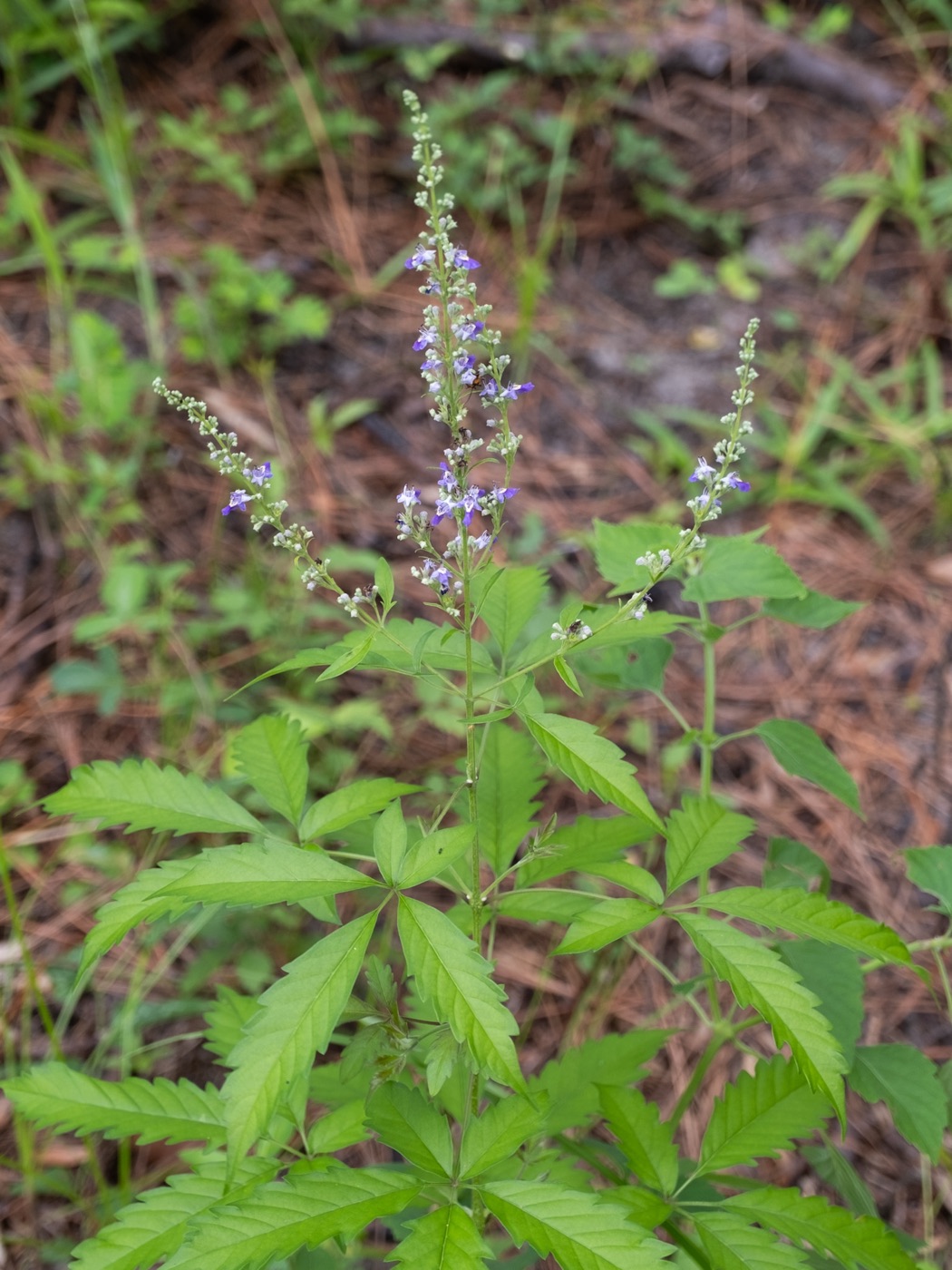

Nirgundi is a hardy shrub whose leaf Ayurveda reaches for again and again in its warm external preparations. Pungent, bitter and heating, it is one of the classic leaves cooked into medicated oils and laid over the limbs as a warm paste or fomentation.
- Botanical name
- Vitex negundo
- Family
- Lamiaceae
- Sanskrit
- निर्गुण्डी
- Part used
- Leaf
- Taste (rasa)
- Pungent and bitter (katu, tikta)
- Quality (guna)
- Light and dry (laghu, ruksha)
- Energy (virya)
- Warming (ushna)
- After digestion (vipaka)
- Pungent (katu)
- Action (karma)
- Reduces swelling and soothes discomfort (shothahara, vedanasthapana)
- Best known for
- The leaf behind classical warm joint oils
What is Nirgundi?
Nirgundi is a tough, fast-growing shrub, Vitex negundo, found across much of India on riverbanks, wasteland and field edges. It is easy to recognise once you know it: slender grey-green branches and leaves that fan out in fives, which is why it is often called the five-leaved chaste tree in English. The leaf is the part Ayurveda values most, especially in oils and preparations for the joints and body, though the root, seed, bark and flower each have their place in some formulations.
The plant belongs to the mint family, Lamiaceae. For a long time it was classed under Verbenaceae, and older books still list it that way, but the genus Vitex was moved to Lamiaceae on genetic evidence in the 1990s, and Lamiaceae is the accepted family today. Among its many Sanskrit names are Sindhuvara and Indrasurasa, and the plant carries a long list of vernacular names across the subcontinent, a sign of how widely and how long it has been used.
What Ayurveda uses it for
The classical texts give Nirgundi a clear and consistent place. Charaka groups it among the Vishaghna substances, understood to counter visha or toxins, and the Krimighna group, understood to counter krimi. Sushruta and Vagbhata place it in the Surasadi gana, a cluster of aromatic, Kapha and Vata reducing plants, and Bhavamishra later lists it in the Guduchyadi group. The nighantus ascribe to the leaf shothahara, a reducing action on swelling, and vedanasthapana, a settling of discomfort.
Reading across the classical literature, the leaf is traditionally described in the following settings, each given in its Sanskrit term with a plain gloss:
- Shotha: swelling and accumulation, the action the texts call shothahara.
- Vedana and Shula: bodily discomfort and griping pain, where its vedanasthapana quality is named.
- Amavata and Sandhigata Vata: the classical conditions of the joints marked by stiffness and heaviness, for which the warm leaf oil is a traditional external application.
- Vrana: wounds, where the fresh leaf is described as a dressing.
- Krimi: the classical category of worms and small organisms.
- Kasa and Shwasa: the cough and laboured breathing of the texts, in which the pungent, drying leaf is mentioned.
- Shiroroga: conditions of the head, including the one-sided head pain the texts call ardhavabhedaka.
These are the traditional textual indications recorded in the classical literature. They describe how Ayurveda has long understood the leaf, especially in its warm external preparations, and are given for reference and study rather than as statements of medical effect.
Its qualities, in plain words
Ayurveda describes every herb through a short list of qualities, and Nirgundi’s read as a set. Its taste is pungent and bitter, the pair of tastes the tradition links with clearing and drying rather than nourishing. Its nature is light and dry, and its potency is heating. After digestion its effect stays pungent.
Put together, this is a warming, drying, lightening herb. Those qualities are the plain opposite of the heavy, cold and moist character of Kapha, and of the mobile, dry and cold character of Vata, which is why the texts describe Nirgundi as reducing both, a Kapha-Vata shamaka. In simple terms, it is the sort of herb the tradition reaches for to counter dampness and heaviness and to bring warmth to a cold, stiff feeling, rather than to feed or moisten.
How it is taken
Nirgundi is above all an external herb. The most classical use is the medicated oil, or taila, in which the leaf is cooked into a base oil so its qualities pass into the oil, which is then warmed and applied. The best known of these is Nirgundi Taila, also called Nirgundyadi Taila, a warm oil for external application over the body and joints.
Beyond oil, the fresh leaf is used as a kalka, a paste or poultice laid warm over an area, and as a warm leaf fomentation. It is taken internally too, as a decoction, kwatha or kashaya, and in some preparations the fresh leaf is pressed for its juice, or swarasa. Across all of these the theme is the same: a warming, drying leaf brought to bear where the tradition sees cold, damp heaviness.
Good to know
Nirgundi is used mostly on the body rather than swallowed, and its warm oil and paste applications belong to a slow, repeated routine rather than a single use. Because its potency is heating, the tradition uses it with more care in people of a heated, Pitta constitution, for whom a warming herb can be less suitable.
This entry describes the classical Ayurvedic understanding of the herb. It is not medical advice, and anyone with a health condition should speak to a qualified practitioner.
Frequently asked
Why is Nirgundi cooked into oils? Because its warming, drying, lightening qualities are exactly what the tradition wants for warm external work on the limbs and joints, and oil is the classical way to carry those qualities into and onto the body. The leaf became a natural choice for medicated oils such as Nirgundi Taila.
Which part of the plant is used? Mainly the leaf, especially in oils and joint preparations. The root, seed, bark and flower are used in some formulations too, but the leaf carries the plant’s main reputation.
Why is it called the five-leaved chaste tree? Because its leaves typically divide into five leaflets that spread like fingers, and it belongs to the chaste tree genus, Vitex. The English name simply describes the leaf and the family.
Nirgundi is counted among the substances that counter toxins and among those that counter krimi.
After the Charaka Samhita, on the classification of dravyas
Sinduvara is placed among the aromatic Kapha and Vata reducing plants of the Surasadi group.
After the Sushruta Samhita, on the Surasadi gana
Frequently asked questions
What is Nirgundi used for in Ayurveda?
Nirgundi, from Vitex negundo, is a leaf Ayurveda has long cooked into warm medicated oils and used in poultices over the joints and body. Its pungent, heating, drying character is classed as shothahara and vedanasthapana, so it is chiefly turned to for reducing swelling and soothing discomfort in stiff, aching joints and the body.
How is Nirgundi used for joint pain?
Classically Nirgundi leaf is cooked into warm medicated oils, or made into a heated poultice, and applied over stiff, aching, swollen joints, matching its warming, drying nature. It is also used within decoctions and formulas. External warm application is the common route for the joints. The preparation is chosen to suit the complaint and used with guidance.
What are the benefits of Nirgundi?
In tradition Nirgundi is valued for reducing swelling, a shothahara action, and easing discomfort, vedanasthapana, in the joints and body through its pungent, heating leaf. It is the leaf behind many classical warm joint oils and poultices. It is used as a supportive external and internal herb for stiffness rather than a single-dose remedy.
Which dosha is Nirgundi for?
Nirgundi's pungent, bitter, heating, drying nature makes it settling for Kapha and Vata, the Doshas Ayurveda links with swelling, stiffness and cold, heavy joints. Being warming, it is used more cautiously where Pitta or heat is high. Its heat suits cold, damp, stiff conditions. A practitioner confirms the picture before use.
Is Nirgundi safe to use?
Used externally in warm oils and poultices Nirgundi is generally well tolerated, though its heating nature suits cold, Kapha and Vata patterns more than hot, Pitta ones. Internal use belongs to classical formulas and a qualified practitioner's dose. It is best avoided in pregnancy without advice. Persistent joint pain still needs proper medical assessment.
References
- Charaka Samhita, on the Vishaghna and Krimighna groups of dravyas.
- Sushruta Samhita, on the Surasadi gana.
- Ashtanga Hridayam, on the Surasadi gana.
- Bhavaprakasha Nighantu, Guduchyadi Varga, entry on Nirgundi.
- Raja Nighantu, entry on Sinduvara.