Materia Medica · Dravyaguna
Udumbara
Ficus racemosa · Moraceae
.jpg)
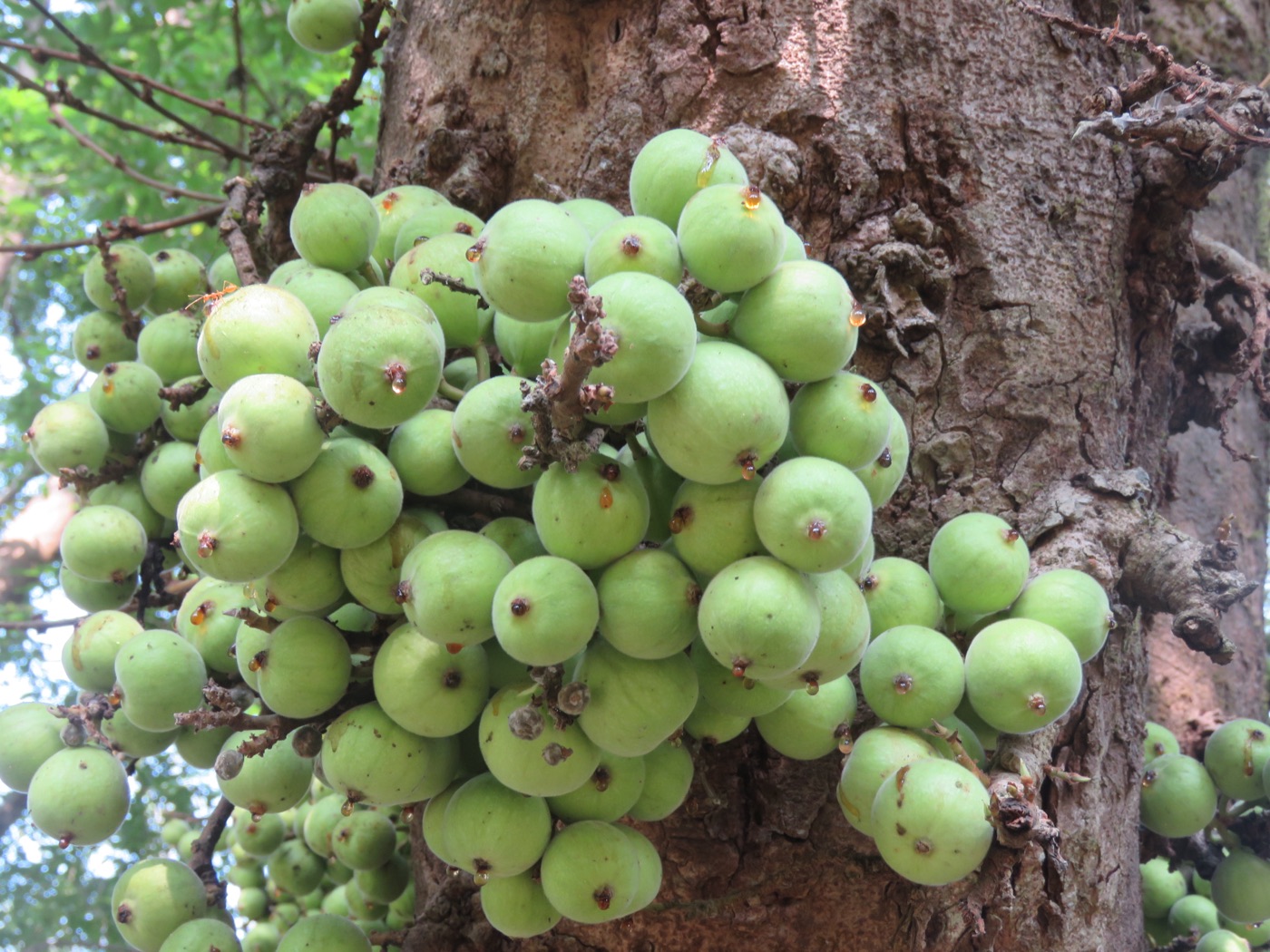
Udumbara is the stem bark of Ficus racemosa, a large fig tree of the Indian countryside whose fruit clusters grow straight from its trunk. In classical Ayurveda it is one of the Panchavalkala, the five astringent fig-family barks, prized for its cooling, drawing-together quality.
- Botanical name
- Ficus racemosa
- Family
- Moraceae
- Sanskrit
- उदुम्बर
- Part used
- Bark (stem bark), with fruit and latex used traditionally
- Taste (rasa)
- Astringent (kashaya)
- Quality (guna)
- Heavy, dry (guru, ruksha)
- Energy (virya)
- Cooling (shita)
- After digestion (vipaka)
- Pungent (katu)
- Action (karma)
- Draws together and settles the surface (sangrahi, ropana)
- Best known for
- an astringent, cooling fig-family bark used traditionally as a wash
What is Udumbara?
Udumbara is the bark of Ficus racemosa, a large fig tree of the mulberry family, Moraceae, that grows widely across the Indian subcontinent. It is often called the cluster fig, because its small figs grow in dense bunches straight from the trunk and older branches rather than out at the tips of the twigs. In Sanskrit the name is उदुम्बर, and the tree has long been a familiar sight near rivers, wells and village settlements.
The part most used in classical Ayurveda is the stem bark, the outer and inner bark of the trunk and thicker branches. The fruit and the milky latex of the tree are also used in traditional practice. Of these, the bark is the principal material, taken from the tree and prepared as described in the classical texts.
What Ayurveda uses it for
In classical Ayurveda, Udumbara bark is one of the principal Kashaya, or astringent, cooling barks. Its best-known place is within the Panchavalkala, the five astringent fig-family barks that are grouped together and used traditionally as a wash and in external applications to clean and settle irritated surfaces of the skin.
The classical texts place Udumbara among named groups of plants that share this astringent, steadying character. In the Charaka Samhita, Sutrasthana chapter 4, it appears in the Kashaya Skandha, the collection of astringent-tasting plants, and among the plants said to steady the flow of fluids in the body. In the Sushruta Samhita, Sutrasthana chapter 38, it is listed in the Nyagrodhadi gana, a family of cooling, astringent barks used together for their drawing-together quality. Its traditional role, then, is that of a cooling, astringent bark used to clean and calm the surface, rather than a plant taken for any single purpose.
Its qualities, in plain words
Ayurveda describes each plant by its taste, its qualities, its energy and its post-digestive effect. For Udumbara these come together in a simple picture.
Its rasa, or taste, is kashaya, astringent. Astringent is the taste that puckers the mouth and feels drying, the sensation of strong tea or an unripe fruit. In Ayurvedic thinking this taste tends to draw things together and firm up soft, loose surfaces.
Its guna, or qualities, are heavy and dry, which fit an astringent bark that has a settling, mopping-up character rather than a light or spreading one. Its virya, or energy, is shita, cooling. A cooling energy is soothing to heat and irritation, much as a cool cloth calms a warm surface.
Its vipaka, the taste that remains after digestion, is katu, pungent. Taken together, these qualities explain why the classical tradition treats Udumbara as a cooling, astringent, tightening bark, well suited to gently cleaning and settling surfaces rather than warming or stimulating them.
How it is taken
In the classical texts Udumbara is most closely tied to external use. As part of the Panchavalkala, the five fig barks are combined and prepared as a decoction, a Kashaya, made by simmering the barks in water. This decoction is then used traditionally as a wash and in external applications to clean and settle the skin surface.
Udumbara therefore appears less as a single herb taken on its own and more as one member of a named group, the Panchavalkala, working alongside the barks of the other fig-family trees. The bark is the material used for this purpose, following the preparations set out in the classical sources. Any use in a personal setting is best guided by a qualified practitioner, who can advise on preparation and proportion.
Good to know
Udumbara is understood in the classical tradition as a cooling, astringent bark whose character is steady and settling rather than quick or warming. Its place in the Panchavalkala means it is most often thought of as part of a group used as a wash, and this shared, external role is worth keeping in mind when reading about it.
Because it belongs to a family of astringent barks used together, timing and course in traditional practice follow the preparation being made rather than a fixed schedule for the single bark. This entry describes the classical Ayurvedic understanding of the herb. It is not medical advice, and anyone with a health condition should speak to a qualified practitioner.
Frequently asked
Is Udumbara the same as the common fig? No. Udumbara is Ficus racemosa, the cluster fig, whose figs grow in bunches directly on the trunk and branches. It is a relative of the common edible fig within the same family, Moraceae, but a different species with its own place in the Ayurvedic texts.
What does Panchavalkala mean? Panchavalkala means the five barks. It is a classical group of five astringent barks from fig-family trees, of which Udumbara is one, brought together and used traditionally as a wash and in external applications.
Which part of the plant is used? The stem bark is the principal part used in classical Ayurveda. The fruit and the milky latex of the tree are also used in traditional practice, but the bark is the main material described for Udumbara.
Udumbara bark is counted among the astringent barks and grouped with the plants that steady the flow of fluids in the body.
After the Charaka Samhita, Sutrasthana
Udumbara is named among the Nyagrodhadi group of astringent, cooling barks used in washes and external applications.
After the Sushruta Samhita, Sutrasthana
Frequently asked questions
What is Udumbara used for in Ayurveda?
Udumbara is the bark of the cluster fig tree, Ficus racemosa, valued in classical Ayurveda as one of the five astringent fig barks used traditionally to clean and settle the surface of the skin. Its karma is described as sangrahi and ropana, drawing together and settling the surface, so the tradition mainly used it externally as a wash.
What is Panchavalkala and where does Udumbara fit?
Panchavalkala is the classical group of five astringent barks from fig-family trees, and Udumbara is one of its members. Together these cooling, astringent (kashaya) barks were prepared as a decoction and used traditionally as a wash for the skin and the surface of wounds. Udumbara contributes its sangrahi, surface-settling quality to the blend.
How is Udumbara bark used?
Udumbara is used chiefly externally, as a decoction of the bark for washing and cleansing the skin and surfaces, alone or within Panchavalkala. Its cooling, astringent nature draws the tissue together. Because such preparations are applied to the skin and to wounds, their strength and use are best guided by a qualified Ayurvedic practitioner.
Is Udumbara cooling or heating?
Udumbara is cooling and astringent. Its taste is kashaya, and its qualities are drying and drawing-together (sangrahi), which is why the tradition uses it to settle and firm the surface of the skin. This cooling, astringent nature suits Pitta and Kapha at the surface rather than dry, Vata-type conditions.
Which dosha does Udumbara balance?
Udumbara chiefly settles Pitta and Kapha at the surface of the body. Its astringent, cooling, drying quality (kashaya, sangrahi) draws tissue together and calms heat and oozing, which is the logic behind its external, skin-cleansing use. Being drying, it is less suited to Vata dryness and is used mainly as a wash rather than internally.
References
- Charaka Samhita, Sutrasthana, chapter 4 (Kashaya Skandha and Mutra Sangrahaniya groups)
- Sushruta Samhita, Sutrasthana, chapter 38 (Nyagrodhadi gana)