Materia Medica · Dravyaguna
Mahabala
Sida rhombifolia · Malvaceae
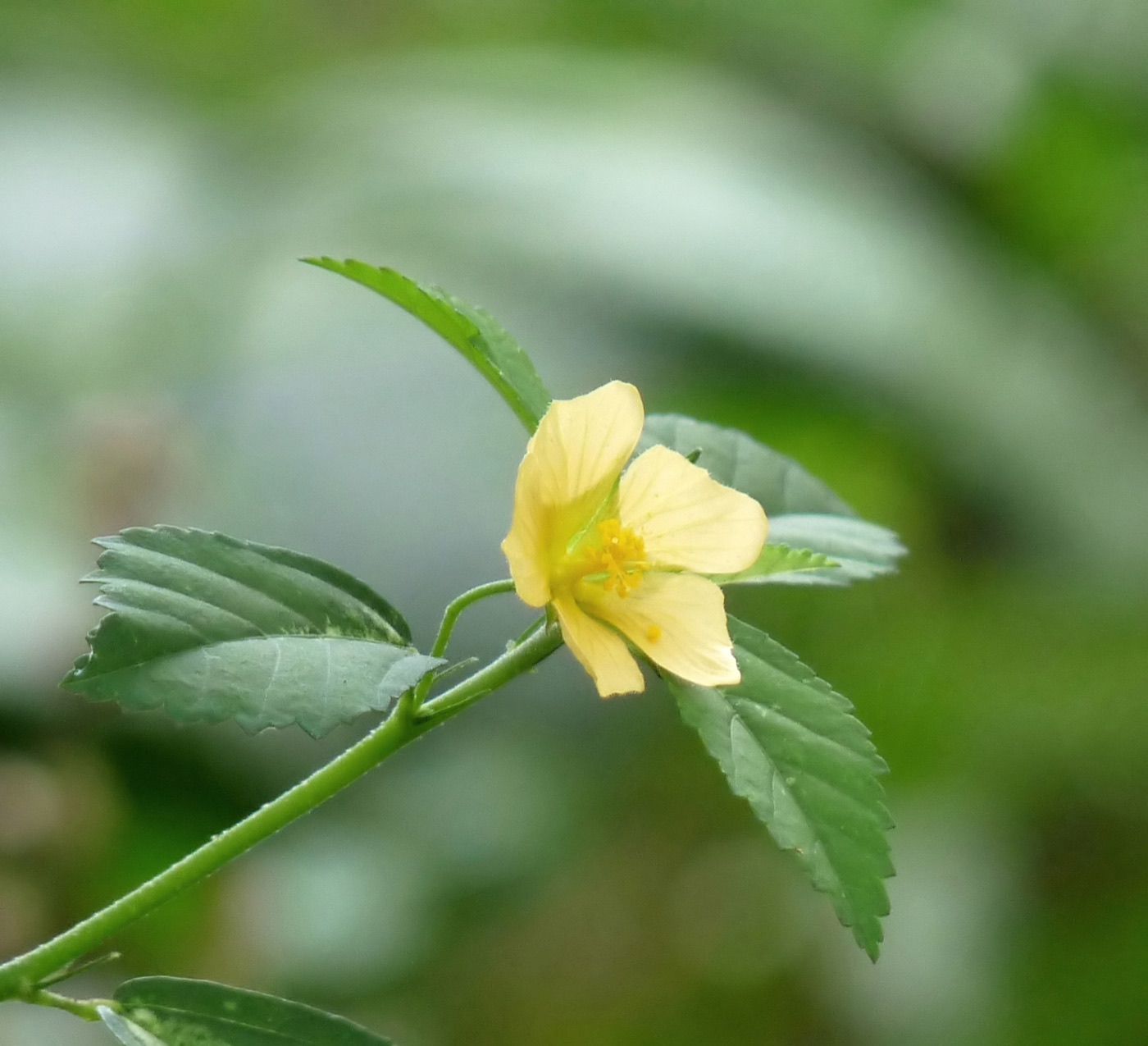

Mahabala is the fourth and greatest-named of the classical Bala herbs, valued for its root. Ayurveda counts it among the strengthening and rejuvenating plants and reaches for it when the body is worn thin and needs building back up.
- Botanical name
- Sida rhombifolia
- Family
- Malvaceae
- Sanskrit
- महाबला
- Part used
- Root
- Taste (rasa)
- Sweet (madhura)
- Quality (guna)
- Light, unctuous and slimy (laghu, snigdha, picchila)
- Energy (virya)
- Cooling (shita)
- After digestion (vipaka)
- Sweet (madhura)
- Action (karma)
- Strengthens, nourishes, rejuvenates and restores (balya, brimhana, rasayana, vrishya)
- Effect on dosha
- Settles Vata and Pitta (vata-pittahara)
- Best known for
- Deep strengthening and settling Vata
What is Mahabala?
Mahabala is the root of Sida rhombifolia, a small shrubby plant of the mallow family that grows widely across the warm parts of India and the tropics beyond. In English it goes by names such as country mallow and arrowleaf sida, the second borrowing from the narrow, diamond-shaped leaves that give the species its botanical name, rhombifolia. It is a modest, wiry plant of roadsides and open ground, easy to walk past without noticing, and it is the root that Ayurveda values, dried and made into powder, decoction or medicated oil.
The name says a great deal in a single word. Bala means strength, and the prefix maha means great, so Mahabala is, quite literally, “the great strength.” The classical writers did not hand out such a name lightly. They set the plant at the head of a small family of “strength” herbs and grouped four of them together: Bala, Atibala, Nagabala and Mahabala, the roots reached for whenever a person needs building back up. Mahabala completes that group of four. In the old synonym lists it carries the further names Mahasamanga and Pitabala, the second pointing to its pale yellow flowers.
Like the other members of its group, the plant has carried a little botanical uncertainty down the centuries, because the several Bala roots share names and are so often described together that a given text is not always precise about which one it intends. What has never been in doubt is the standing of the root in the tradition, and the sense conveyed by its name, that among the strengthening roots this is the great one.
What Ayurveda uses it for
In the classical texts Mahabala is counted among the Balya herbs, the strengthening group, and it belongs equally to the Rasayana or rejuvenating plants and the Brimhana group that nourishes and fills out the tissues. It is also named as a Vrishya, a restorative for reproductive vitality. Its sweet, cooling and unctuous nature was understood to feed a depleted frame and to settle both the dry, restless quality of Vata and the heat of Pitta, so that its reach runs a little wider than the warmer plants of the wider herbal world, in the manner of its cousin Nagabala.
The situation the texts most often describe is a familiar one: a body that is depleted, dry and tired. After long illness, hard work or simply the dryness that gathers with age, when the wind-like quality the tradition calls Vata has risen and the frame feels light, restless and worn, Mahabala is brought in to feed and ground such a person, to settle the restlessness and slowly rebuild strength. Of the four Bala roots, the tradition treats Mahabala as the deepest builder, the one whose name promises the fullest strengthening.
Within that role the dravyaguna texts describe the root as traditionally indicated in a familiar set of conditions, each named here in its classical Sanskrit term with a plain gloss:
- Vata-vyadhi: the broad class of Vata disorders, the root’s foremost domain, given its Vata-settling nature.
- Daurbalya and Karshya: debility and thinness, the classical uses that follow from its place as a strengthener.
- Kshaya: wasting and depletion, where its building, nourishing quality is called upon.
- Raktapitta: the classical bleeding tendency, for which its cooling nature was thought suited.
- Hridroga: as a Hridya support to the heart, in keeping with its nourishing, settling character.
- Shukra-daurbalya: reproductive weakness, in keeping with its place among the restorative herbs.
These are the traditional textual indications recorded in the classical literature. They set out how Ayurveda has long understood the herb and are given for reference and study, not as statements of medical effect or as advice to treat any condition.
Its qualities, in plain words
Ayurveda describes every herb by a short list of qualities, and for Mahabala they line up neatly behind its reputation as the great builder of its group.
Its taste is sweet, and in Ayurveda a sweet taste is the taste of nourishment, the one that feeds and grounds the body rather than wearing it down. It is light, so it nourishes without sitting heavily, yet at the same time unctuous and a little slimy, which is exactly the opposite of the dry, rough quality of disturbed Vata, and the reason the tradition trusts it to moisten and soothe. It is cooling, which is why it suits heat and irritation, and why the classical writers extend its care to the Pitta dosha as well as to Vata. And it finishes sweet after digestion, its vipaka being sweet, a sign that it builds tissue steadily over time rather than in a single stroke.
Put those qualities together and you have a herb that nourishes, calms and moistens all at once: light enough to be taken as a long tonic, oily and slimy enough to answer the dryness of Vata, and cool enough to be trusted where there is heat. This is why the sources settle on its double action of settling both Vata and Pitta, and why, of the four strengthening roots, Mahabala is the one whose name and qualities together mark it as the deepest of the builders.
How it is taken
The usual form is the root powder, or churna. The dried root is ground and, being a sweet and cooling tonic, is most often stirred into warm milk, the vehicle Ayurveda favours for carrying a nourishing action into the body. Taken this way it is treated in the same manner as the other strengthening roots, as steady food for a worn frame rather than as a remedy for a single day.
It is also taken as a decoction, or kashaya, prepared from the root and taken by the cupful, a form the classical writers used where a lighter, more penetrating preparation suited the need. From these two forms, the powder and the decoction, the tradition built a wider range of strengthening preparations, and Mahabala appears within the family of Balya and Rasayana formulas alongside its cousins Bala, Atibala and Nagabala.
Above all, Mahabala is one of the great oil herbs. Along with the other roots of its group it is cooked into strengthening medicated oils, the best known of which carry the group’s own name, the Bala and Mahabala tailas, oils in which the Bala roots form the backbone and in which their sweet, cooling and unctuous nature is set to the settling of Vata. These oils are used on the body and in the milk-cooked preparations of the tradition, and it is partly through them that the name of the root travels so widely across the classical literature.
As with the strengthening roots generally, Mahabala is taken as a course over time, as nourishment, rather than as a single dose. It belongs to the slow side of Ayurveda, the side that builds and restores gradually.
Good to know
There are four related plants that the old texts distinguish within this strengthening family: Bala, Atibala, Nagabala and Mahabala. They are close cousins, used in similar ways, and the name of each is built on the same word for strength. Bala is the most commonly named of the four, Nagabala is valued particularly for reaching both Vata and Pitta at once, and Mahabala, “the great strength,” completes the group and is treated as its deepest builder. Because the several members share names and are described together, the classical sources sometimes differ over which plant a given text intends, which is one reason the botanical identity of Mahabala, like that of its cousins, has long carried a little uncertainty.
This entry describes the classical Ayurvedic understanding of the herb. It is not medical advice, and anyone with a health condition should speak to a qualified practitioner.
Frequently asked
What does the name Mahabala mean? Bala means strength, and the prefix maha means great, so Mahabala is literally “the great strength.” The name places the root at the head of the classical “strength” herbs, the group of four that also holds Bala, Atibala and Nagabala. In the old synonym lists it also carries the names Mahasamanga and Pitabala.
Which part of the plant is used? Chiefly the root. It is the root that carries the strengthening reputation in the classical literature, that is stirred into milk as a powder or taken as a decoction, and that is cooked into the strengthening medicated oils.
How does Mahabala differ from Bala? They are close relatives in the same strengthening group and used in similar ways. Bala is Sida cordifolia, while Mahabala is Sida rhombifolia. Where the sources agree Bala most firmly with the settling of Vata, Mahabala is described as the deeper builder of the group, cooling enough to settle both Vata and Pitta and named, by its very prefix, for the greatest strength.
Is Mahabala used in medicated oils? Yes. Along with the other Bala roots it is one of the classical oil herbs, cooked into strengthening medicated oils such as the Bala and Mahabala tailas, where the Bala roots form the backbone and their sweet, cooling, unctuous nature is set to the settling of Vata.
Mahabala is sweet and cooling; it strengthens the body, nourishes the tissues and settles the wind that has gone astray.
After the Bhavaprakasha Nighantu, on the Bala group of strengthening herbs
Among the four are counted Bala, Atibala, Nagabala and Mahabala, the roots that give strength.
After the classical Nighantu listing of the Bala group
Frequently asked questions
What is Mahabala used for in Ayurveda?
Mahabala (Sida rhombifolia) is the greatest of the classical Bala roots, valued in Ayurveda as a deeply nourishing, strengthening tonic. The texts class its action as balya, brimhana, rasayana and vrishya, and it settles Vata and cools Pitta (vata-pittahara). Ayurveda reaches for it to rebuild strength and steady the body, chiefly within medicated oils and tonics.
Which dosha is Mahabala for?
Mahabala is classed as vata-pittahara, settling Vata and cooling Pitta. Its sweet taste and nourishing, strengthening nature make it well suited to Vata-driven weakness and depletion while also easing Pitta's heat. This makes it a favoured tonic root where the body is run down and unsteady. It is used within formulations chosen to fit the constitution.
What is the difference between Bala and Mahabala?
Both belong to the classical Bala group of strengthening roots, and their names tell the relation: Bala is the strengthener, Mahabala the greater one. They share a sweet, nourishing, Vata-settling character and often stand in for one another in tonics and medicated oils. Mahabala is regarded as the more powerful of the Bala roots for deep strengthening.
How is Mahabala taken?
Mahabala is used chiefly within classical preparations, notably medicated oils for Vata and strengthening tonics, rather than as a casual stand-alone powder. Its balya, brimhana and rasayana actions are drawn out through these formulations. For internal tonic use the dose and form should be set by a qualified practitioner, who will match it to your constitution and need.
Is Mahabala a Rasayana?
Yes, Ayurveda classes Mahabala as a rasayana alongside its balya, brimhana and vrishya actions, making it a rejuvenating, strengthening root. As the greatest of the Bala group it is valued for deep nourishment of the body while settling Vata and cooling Pitta. Its rejuvenating benefit is gradual, drawn out over a steady course within suitable classical formulations.
References
- Charaka Samhita, Sutrasthana, chapter 4 (Shadvirechanashatashritiya), among the strengthening (balya) and restorative (brimhana) herbs.
- Sushruta Samhita, among the Vidarigandhadi gana of nourishing roots and the Vata-pacifying group.
- Bhavaprakasha Nighantu, Guduchyadi Varga, entry on the Bala group naming Bala, Atibala, Nagabala and Mahabala.
- Raja Nighantu, listing the synonyms of Mahabala including Mahasamanga and Pitabala.
- Ashtanga Hridaya, on the Bala-group oils cooked for the settling of Vata.