Materia Medica · Dravyaguna
Nagabala
Grewia hirsuta · Malvaceae
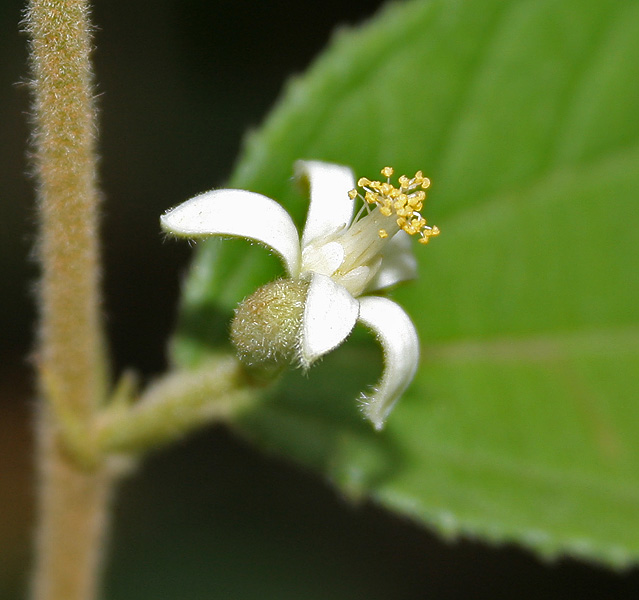
_in_Talakona_forest%2C_AP_W_IMG_8286.jpg)
Nagabala is one of the classical Bala herbs, valued for its root. Ayurveda counts it among the strengthening and rejuvenating plants and reaches for it when the body is worn thin and needs building back up.
- Botanical name
- Grewia hirsuta
- Family
- Malvaceae
- Sanskrit
- नागबला
- Part used
- Root
- Taste (rasa)
- Sweet (madhura)
- Quality (guna)
- Light and unctuous (laghu, snigdha)
- Energy (virya)
- Cooling (shita)
- After digestion (vipaka)
- Sweet (madhura)
- Action (karma)
- Strengthens, nourishes, rejuvenates and restores (balya, brimhana, rasayana, vrishya)
- Effect on dosha
- Settles Vata and Pitta (vata-pittahara)
- Best known for
- Rebuilding strength and settling Vata and Pitta
What is Nagabala?
Nagabala is the root of Grewia hirsuta, a small shrubby plant of the mallow family that grows across the warm parts of India. It is a modest plant, easy to pass without a second glance, and it is the root that Ayurveda values, dried and made into powder or cooked into nourishing preparations. Some of the older books place the plant in the Tiliaceae, and a few classical sources associate the name with a Sida species rather than a Grewia, so the botanical identity has long carried a little uncertainty. What has never been in doubt is the standing of the root in the tradition.
The name itself points to that standing. Bala means strength, and the prefix naga, which can mean a serpent or an elephant, lends the sense of something large or powerful. Nagabala is therefore one of a small family of “strength” herbs, and the classical writers group four of them together: Bala, Atibala, Nagabala and Mahabala, the roots reached for whenever a person needs building back up. The plant carries the further name Gangeruki in the old lists, and is sometimes called Gulsakari.
What Ayurveda uses it for
In the classical texts Nagabala is counted among the Balya herbs, the strengthening group, and it belongs equally to the Rasayana or rejuvenating plants and the Brimhana group that nourishes and fills out the tissues. It is also named as a Vrishya, a restorative for reproductive vitality. Its sweet, cooling and unctuous nature was understood to feed a depleted frame and to settle both the dry, restless quality of Vata and the heat of Pitta, which is what sets it a little apart from its cousins in the Bala group.
Within that role the dravyaguna texts describe the root as traditionally indicated in a familiar set of conditions, each named here in its classical Sanskrit term with a plain gloss:
- Daurbalya and Karshya: debility and thinness, the root’s foremost use as a strengthener.
- Vata-vikara: the broad class of Vata complaints, given its Vata-settling action.
- Kshaya: wasting and depletion, where its building, nourishing quality is called upon.
- Bhagna: as a support to broken bone, one of the classical uses of the whole Bala group.
- Raktapitta: the classical bleeding tendency, for which its cooling nature was thought suited.
- Shukra-daurbalya: reproductive weakness, in keeping with its place among the restorative herbs.
These are the traditional textual indications recorded in the classical literature. They set out how Ayurveda has long understood the herb and are given for reference and study, not as statements of medical effect or as advice to treat any condition.
Its qualities, in plain words
Ayurveda describes every herb by a short list of qualities, and for Nagabala they line up neatly behind its reputation as a builder.
Its taste is sweet, and in Ayurveda a sweet taste is the taste of nourishment, the one that feeds and grounds the body rather than wearing it down. It is light and unctuous, an unusual pairing that lets it nourish without sitting heavily. It is cooling, which is why it suits heat and irritation, and why the tradition trusts it with the Pitta dosha as well as with Vata. And it finishes sweet after digestion, a sign that it builds tissue over time. Put together, these qualities describe a light, cool, nourishing root, and this is why the sources settle on its double action of settling both Vata and Pitta, a reach a little wider than the warmer members of its group.
How it is taken
The usual form is the root powder, or churna. The dried root is ground and, being a sweet and cooling tonic, is most often stirred into warm milk, the vehicle Ayurveda favours for carrying a nourishing action into the body.
From that powder the classical writers built a range of strengthening preparations, and Nagabala appears within the wider family of Balya and Rasayana formulas alongside its cousins Bala, Atibala and Mahabala. As with the other roots of this group, it is also cooked into medicated oils and into milk-cooked preparations, where its sweet and cooling nature suits the settling of Vata. Like the strengthening roots generally, it is taken as a course over time, as nourishment, rather than as a single dose.
Good to know
There are four related plants that the old texts distinguish within this strengthening family: Bala, Atibala, Nagabala and Mahabala. They are close cousins, used in similar ways, with Bala the most commonly named of the four and Nagabala valued particularly for reaching both Vata and Pitta at once. Because the several members share names and are described together, the classical sources sometimes differ over which plant a given text intends, which is one reason the botanical identity of Nagabala has long carried a little uncertainty.
This entry describes the classical Ayurvedic understanding of the herb. It is not medical advice, and anyone with a health condition should speak to a qualified practitioner.
Frequently asked
What does the name Nagabala mean? Bala means strength, and the prefix naga, which can stand for a serpent or an elephant, lends the sense of something large or powerful. The name places the root among the classical “strength” herbs, the group of four that also holds Bala, Atibala and Mahabala.
Which part of the plant is used? Chiefly the root. It is the root that carries the strengthening reputation in the classical literature and that is named for the nourishing preparations.
How does Nagabala differ from Bala? They are close relatives in the same strengthening group and used in similar ways. Where the sources agree Bala most firmly with settling Vata, Nagabala is described as cooling enough to settle both Vata and Pitta, which is the quality most often noted to set it apart.
Nagabala is sweet and cooling; it strengthens the body, nourishes the tissues and settles both the Vata and the Pitta dosha.
After the Bhavaprakasha Nighantu, on the Bala group of strengthening herbs
Among the four are counted Bala, Atibala, Nagabala and Mahabala, the roots that give strength.
After the classical Nighantu listing of the Bala group
Frequently asked questions
What is Nagabala used for in Ayurveda?
Nagabala (Grewia hirsuta) is a root of the classical Bala group, valued in Ayurveda as a nourishing, strengthening tonic that settles both Vata and Pitta. The texts describe its action as balya, brimhana, rasayana and vrishya, with a purely sweet taste (madhura). It is best known for rebuilding strength and steadying a depleted Vata-Pitta constitution.
What is the difference between Bala and Nagabala?
Bala and Nagabala both belong to the same classical Bala group of strengthening herbs and share a sweet, nourishing, Vata-Pitta settling character. Bala (Sida cordifolia) is the most widely used, while Nagabala (Grewia hirsuta) is a related member of the group used similarly as a balya and Rasayana tonic. They are close in action, differing mainly in botanical source.
What are the benefits of Nagabala?
Ayurveda associates Nagabala with building strength (balya), nourishing and bulking the tissues (brimhana), rejuvenation (rasayana) and reproductive vitality (vrishya). Its sweet taste and Vata-Pitta settling nature suit a run-down, dry or depleted state. These are classical descriptions of its Rasayana action within the tradition rather than claims to treat any named modern condition.
How do you take Nagabala?
The root is used, taken as a powder or decoction and often with milk, which suits its sweet, nourishing nature, and it appears in classical strengthening formulations. As a Rasayana it is taken as a steady tonic over time. Because dose depends on your constitution, confirm it with a qualified Ayurvedic practitioner, especially for prolonged use.
Which dosha does Nagabala balance?
Nagabala settles both Vata and Pitta (vata-pittahara). Its sweet, cooling, nourishing quality soothes the dryness of Vata and the heat of Pitta at once, which is why the tradition values it for a depleted, dry or overheated constitution. Being heavy and nourishing, it is used more sparingly where Kapha or weak digestion predominates.
References
- Charaka Samhita, Sutrasthana, chapter 4 (Shadvirechanashatashritiya), among the strengthening (balya) and restorative (brimhana) herbs.
- Sushruta Samhita, among the Vidarigandhadi gana of nourishing roots and the Vata-pacifying group.
- Bhavaprakasha Nighantu, Guduchyadi Varga, entry on the Bala group naming Bala, Atibala, Nagabala and Mahabala.
- Raja Nighantu, listing the synonyms of Nagabala including Gangeruki.