Materia Medica · Dravyaguna
Trivrit
Operculina turpethum · Convolvulaceae
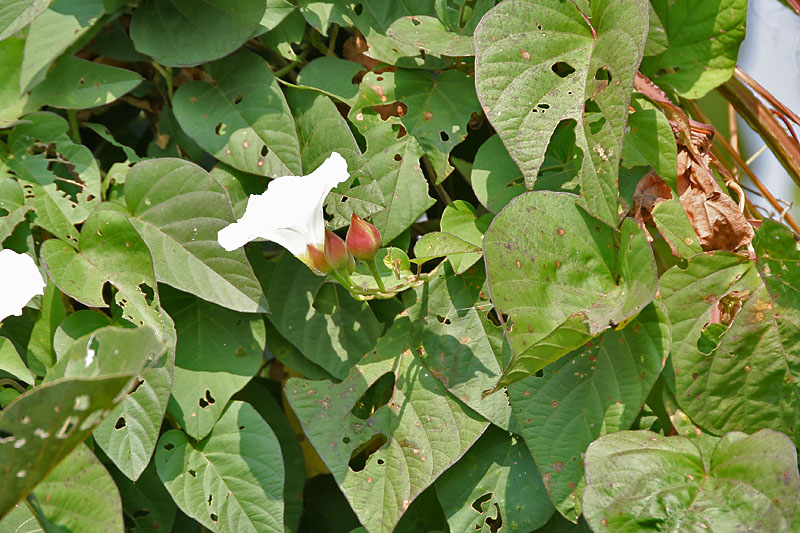
_in_Kawal%2C_AP_W_IMG_2211.jpg)
Trivrit is the root of a climbing plant whose long, twisting stems give it its name. It is one of Ayurveda's principal purgatives, reached for when the tradition wants to clear the body downward, and it is a herb the classical writers handle with respect.
- Botanical name
- Operculina turpethum
- Family
- Convolvulaceae
- Sanskrit
- त्रिवृत्
- Part used
- Root and root-bark
- Taste (rasa)
- Pungent and bitter (katu, tikta)
- Quality (guna)
- Light, dry and penetrating (laghu, ruksha, tikshna)
- Energy (virya)
- Warming (ushna)
- After digestion (vipaka)
- Pungent (katu)
- Action (karma)
- Purges and breaks up, clears Kapha and Pitta (rechana, bhedana, kaphapittahara)
- Best known for
- The classical purgative root, used with care
What is Trivrit?
Trivrit is the root of a climbing plant, Operculina turpethum, a twining vine of the morning-glory family that trails and coils over hedges and other plants across the warm country of India. Older botanical writing knew the same plant as Ipomoea turpethum. The vine is unremarkable to look at, with slender winged stems and pale funnel-shaped flowers. It is the root, dug up and dried, that Ayurveda has long valued, and it is the root-bark in particular that carries the plant’s strength.
The name is drawn from the stems. Trivrit means “thrice-turned” or “coiled,” a plain picture of the way the vine winds around whatever it climbs. In English the same plant is called turpeth or Indian jalap, the second name marking it as a cousin of the true jalap and, like it, a purgative. In the classical and later Ayurvedic writing it is also widely known as Nishotha.
The tradition recognises two kinds of the plant, and the distinction matters. Shweta Trivrit, the white variety, is the milder of the two and the one the texts prefer for ordinary use. Shyama or Krishna Trivrit, the black variety, is considered stronger and sharper in its action, and the classical writers ask for greater caution with it. Where the sources speak simply of Trivrit, it is usually the white kind they intend.
What Ayurveda uses it for
Trivrit belongs above all to Virechana, the therapy of downward purgation, and it is one of the herbs the classical writers name first when the aim is to clear the body by that route. They place it among the Rechana drugs, those that move the bowels downward, and among the Bhedana group, those that break up and dislodge what has gathered and settled. Its light, dry, penetrating and warming nature was understood to loosen and carry away accumulated Kapha and Pitta, the two doshas it is said to pacify.
Within that role the dravyaguna texts describe the root as traditionally indicated in a familiar set of conditions, each named here in its classical Sanskrit term with a plain gloss:
- Vibandha: constipation, the retention of the bowels that a purgative root is the direct answer to.
- Udara: abdominal distension and the classical group of belly disorders, where a downward-clearing action is called upon.
- Shotha: swelling and accumulation, addressed through the herb’s draining, purgative quality.
- Kushtha: the broad classical category of skin disorders, for which purgation was a traditional line of treatment.
- Gulma: abdominal masses and hardenings, matched to the herb’s breaking-up, bhedana nature.
- Jwara: fever, where clearing the body downward was part of the classical approach.
- Arsha: haemorrhoids, among the conditions the texts connect with this root.
These are the traditional textual indications recorded in the classical literature. They set out how Ayurveda has long understood the herb and are given for reference and study, not as statements of medical effect or as advice to treat any condition.
Its qualities, in plain words
Ayurveda describes every herb by a short list of qualities, and for Trivrit they line up clearly behind its work as a purgative.
Its taste is pungent, with a bitter edge, and both of these are tastes the tradition links with clearing and reducing rather than nourishing. It is light, dry and penetrating, a combination that lets it reach into the tissues, loosen what is lodged there and move it along, rather than feeding or grounding the body. It is warming, which helps it stir and mobilise. And it finishes pungent after digestion, a sign that it lightens and clears rather than builds. Put together, these qualities describe a light, dry, sharp and warming root, which is exactly why the tradition settles on its downward-purging action and its clearing of the heavier Kapha and the hot Pitta. Because that same lightness, dryness and heat can unsettle Vata, the sources treat it as a herb to use with judgement rather than freely.
How it is taken
The classical form is the powder of the dried root, or churna, and it is the white variety that the texts prefer for this. As a purgative it is a herb of measured use: the dose and the timing are chosen with care, and the classical writers set it within the wider preparation and after-care that Virechana therapy calls for, rather than treating it as something taken casually.
From the root the classical writers built a number of named preparations. Trivrit appears by name in Trivrit Lehya, also called Trivrit Avaleha, a classical purgative confection in which the sharpness of the root is softened into a palatable paste. It is one of the ingredients of Abhayadi Modaka, a medicated sweet of the same clearing family. And it stands among the recognised Virechana drugs of Panchakarma, the group of herbs the tradition draws on when purgation is the chosen therapy.
Good to know
Trivrit is not one of the gentle, building herbs. It is a strong Rechana, a purgative, and the classical writers treat it accordingly. In the tradition it is a substance given under a practitioner’s guidance and within the proper preparation that purgation therapy asks for, and it is not considered suited to those who are weak or depleted, to the very young, or to the pregnant. The two varieties are handled differently too: the white Shweta kind is the milder and the one preferred for ordinary use, while the black Shyama kind is stronger and asks for greater caution. Used without that care, a purgative of this strength can disturb rather than settle the body, which is why the sources are so deliberate about it.
This entry describes the classical Ayurvedic understanding of the herb. It is not medical advice, and anyone with a health condition should speak to a qualified practitioner.
Frequently asked
Why is it called “thrice-turned”? Because the Sanskrit name Trivrit describes the plant’s twining stems, which coil and wind around whatever they climb. The English name turpeth, and the older name Nishotha, refer to the same vine, whose dried root is the part Ayurveda uses.
What is the difference between the white and black kinds? The tradition recognises two varieties. Shweta (white) Trivrit is the milder and the one the classical texts prefer for ordinary use, while Shyama or Krishna (black) Trivrit is stronger and used with more caution. When the sources say simply “Trivrit,” they usually mean the white kind.
Which part of the plant is used? The root, and the root-bark in particular, which carries most of the herb’s strength. It is dried and ground to powder, and it is this that the classical purgative preparations call for.
Trivrit is pungent and warming; it moves the bowels downward and carries away the accumulated Kapha and Pitta.
After the Bhavaprakasha Nighantu, on the purgative herbs
The white variety is the milder and is preferred for use; the black is stronger and to be given with greater care.
After the Bhavaprakasha Nighantu, on the two varieties of Trivrit
Frequently asked questions
What is Trivrit used for in Ayurveda?
Trivrit is a twining root (Operculina turpethum) that Ayurveda counts among its chief purgatives. It is valued for moving the bowels downward and clearing Kapha and Pitta, classed as rechana, bhedana and kaphapittahara. It is a key herb in Virechana, the therapeutic purgation, and is always given with care under a qualified physician.
Is Trivrit a purgative?
Yes, Trivrit is one of Ayurveda's principal purgative roots, classed as rechana and bhedana, meaning it purges and breaks up, clearing Kapha and Pitta downward. It is central to Virechana, the classical purgation therapy. Because it is a potent purgative, the dose must be exact and it should only be used under a qualified Ayurvedic physician.
How is Trivrit used in Virechana?
In Virechana, the therapeutic purgation, Trivrit is one of the chief roots given to draw excess Pitta and Kapha downward and out through the bowels, usually after proper preparation of the body with oleation and sweating. The dose and timing are precisely set. This is a clinical Panchakarma procedure carried out only under a trained Ayurvedic physician.
Is Trivrit safe to take?
Trivrit is a potent purgative and is always given with care. Used correctly under a qualified physician it is a valued Virechana herb, but wrong dosing can cause harsh purgation and depletion. It is not for casual or self-directed use, and those who are pregnant, weak or debilitated should avoid it. Use it only under professional supervision.
Which dosha does Trivrit clear?
Trivrit clears Kapha and Pitta (kaphapittahara), drawing them downward and out through purgation. Its pungent and bitter tastes and its rechana, bhedana actions suit removing excess Pitta above all, which is why it anchors Virechana. Being strongly downward-moving and purgative, it is used carefully where Vata is high, and only under a qualified physician's guidance.
References
- Charaka Samhita, Sutrasthana, among the herbs of downward purgation (bhedaniya and rechana), and in the Kalpasthana on Trivrit.
- Sushruta Samhita, among the Shyamadi and Adhobhagahara (downward-acting) herbs used in Virechana.
- Ashtanga Hridaya, Kalpasiddhi Sthana, on the use of Trivrit in purgation therapy.
- Bhavaprakasha Nighantu, entry on Trivrit (Nishotha) with its two varieties and properties.
- Raja Nighantu, listing the Sanskrit synonyms and the white and black kinds of the plant.